



FITNESS
FOCUS
GLP-1 medications have changed the conversation around weight loss.
Medications containing semaglutide or tirzepatide are helping many people achieve significant reductions in body weight. But there is another conversation that deserves just as much attention:
What are you doing to become stronger while you’re losing weight?
Because successful weight loss isn’t only about seeing a smaller number on the scale.
It’s about improving your body composition, strength, mobility, fitness and overall health along the way.
If you’re currently taking a GLP-1 medication under the care of your healthcare provider, exercise, and especially strength training, can be an important part of the bigger picture.
First: What Are GLP-1 Medications?
GLP-1 receptor agonists are medications that affect pathways involved in appetite, food intake and blood-sugar regulation. Semaglutide is one example. Tirzepatide acts on both GIP and GLP-1 receptors.
These medications may reduce appetite and calorie intake, which can contribute to substantial weight loss. The FDA’s current prescribing information for Wegovy notes that semaglutide reduces body weight with greater loss of fat mass than lean mass.
That’s an important distinction.
Weight loss isn’t always just fat loss.
When someone loses a significant amount of body weight, some of that loss can include lean tissue as well. Research examining tirzepatide has similarly shown reductions in both fat mass and lean mass during weight loss.
That doesn’t mean GLP-1 medications are somehow “bad for muscle.”
It means that preserving muscle should be part of the strategy whenever significant weight loss is occurring.
Your Goal Shouldn’t Just Be to Weigh Less
Imagine two people each lose 30 pounds.
One loses primarily body fat while maintaining much of their muscle and becoming stronger.
The other loses weight but does very little resistance training, becomes weaker and loses more lean tissue along the way.
The scale might congratulate both of them equally.
Your body won’t.
This is why we encourage our clients at Outlaw FitCamp to look beyond body weight.
The better questions are:
- Are you getting stronger?
- Are you maintaining or building muscle?
- Is your body-fat percentage changing?
- Is everyday movement becoming easier?
- Is your cardiovascular fitness improving?
- Do you have more energy?
- Are you building habits you can maintain?
Those markers tell us far more about your fitness than a single number on a bathroom scale.
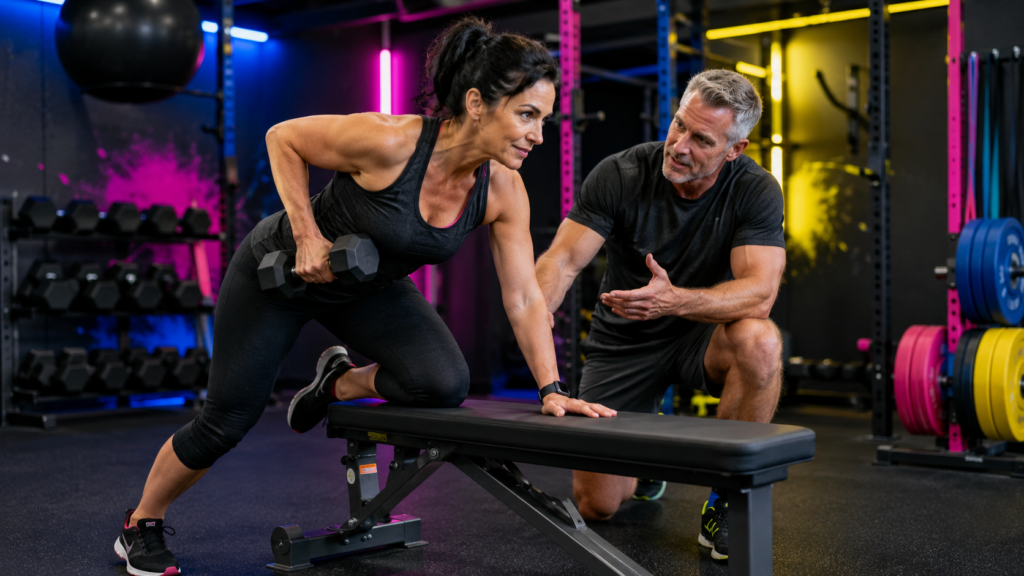

Why Strength Training Matters When Taking a GLP-1
Resistance training gives your body a reason to keep muscle.
When you challenge your muscles through progressively appropriate resistance, you’re sending a very different message to the body than you would through calorie restriction alone.
Recent clinical guidance addressing nutrition and GLP-1 therapy specifically emphasizes resistance training and appropriate nutrition as important strategies for preserving muscle and bone during weight loss.
And strength training isn’t something you suddenly need because you’re taking medication.
It’s something adults should already be doing.
Current U.S. Physical Activity Guidelines recommend that adults perform muscle-strengthening activity involving the major muscle groups at least two days each week, along with regular aerobic activity.
For adults over 35, that becomes an increasingly important conversation.
Your training shouldn’t only be about burning calories.
It should be about building and protecting the body you’re going to live in for the next several decades.
Protein Matters Too
GLP-1 medications can substantially reduce appetite. For some people, that means eating significantly less food than they did before.
While reduced calorie intake may support weight loss, eating less also makes the quality of the food you do eat more important.
Adequate protein intake, resistance exercise, hydration and sufficient micronutrient intake are among the nutritional priorities experts recommend considering during GLP-1-supported weight loss.
Your individual nutritional needs can vary based on your age, body size, health conditions, medications, goals and activity level, so specific nutrition recommendations should be discussed with an appropriate healthcare or nutrition professional.
The takeaway is simple:
Don’t let “I’m not hungry” accidentally become “I’m not fueling my body.”
Cardio Is Important, But Don’t Skip the Weights
Walking is excellent.
Cardio is excellent.
FitCamp is excellent.
Strength training is also essential.
This does not need to become a battle between cardio and weights, despite the fitness industry’s strange fondness for turning perfectly compatible things into rival sports teams.
Adults benefit from both aerobic activity and muscle-strengthening exercise.
For someone using a GLP-1 medication, a well-rounded program might include:
- Progressive strength training
- Cardiovascular exercise
- Functional movement
- Mobility
- Adequate recovery
- Appropriate nutrition
- Regular measurement of progress
The exact combination should match your fitness level, medical circumstances and goals.
Stop Measuring Success With Only a Scale
If you’ve lost 20 pounds, that’s useful information.
But it isn’t the whole story.
At Outlaw FitCamp, we believe body composition gives you a much better picture of what’s happening.
An InBody body-composition assessment can help establish a baseline and track changes in measurements such as body weight, estimated body fat and lean mass over time.
Instead of asking only:
“How much weight did I lose?”
We want our clients asking:
“How is my body changing?”
That’s a much more useful conversation.
And it gives your trainer more information to help guide your program.

What If You Haven’t Worked Out in Years?
This is where people tend to make one of two choices.
They either do nothing because they feel intimidated.
Or they decide Monday morning is the appropriate time to train like they’re preparing for the NFL Combine.
Neither is particularly helpful.
You don’t need to already be fit before starting a fitness program.
And you don’t need to destroy yourself during your first week.
Your starting point might be two strength-training sessions per week.
It might be Personal Training.
It might be FitCamp.
It might be walking combined with resistance training.
The goal is to start at the right level and progressively build from there.
The federal physical-activity guidelines reinforce this approach: even smaller amounts of physical activity provide benefits, and adults can progressively work toward higher recommended activity levels.
Consistency beats punishment.
Every time.
GLP-1 Medications Can Be a Tool. Build the Rest of the Toolbox.
Medication may help address appetite and support weight loss.
But medication doesn’t teach you how to squat.
It doesn’t make you stronger.
It doesn’t improve your push-up.
It doesn’t teach you proper movement.
It doesn’t build a workout routine into your week.
And it doesn’t replace the confidence that comes from realizing your body can do something today that it couldn’t do three months ago.
That’s where training comes in.
The goal isn’t simply to become a smaller version of yourself.
It’s to become a stronger, healthier and more capable version of yourself.
How Outlaw FitCamp Can Help
If you’re using a GLP-1 medication and want to incorporate fitness into your journey, you don’t have to figure everything out alone.
At Outlaw FitCamp by Jesse James, our coaches can help you establish your starting point and create a training approach based on your fitness level and goals.
Depending on your needs, that may include:
Personal Training
Individualized coaching with programming built around your goals, abilities and progress.
30-Minute FitCamp Workouts
Coach-led functional workouts designed to help improve strength, conditioning and overall fitness without spending hours in the gym.
InBody Body-Composition Testing
Go beyond body weight and track how your body composition changes over time.
Accountability and Coaching
Because knowing what to do and consistently doing it are two very different human activities.
Make Your Weight-Loss Journey About More Than the Scale
If you’re losing weight with the help of a GLP-1 medication, this may be an incredible opportunity to invest in something even bigger:
your strength.
Build muscle.
Improve your fitness.
Learn how to train.
Track your progress.
Create habits you can maintain.
And focus on becoming stronger while the scale is moving.
Ready to get started?
Schedule your InBody assessment or talk with an Outlaw FitCamp coach to determine the best training option for your goals.
MAKE FIT HAPPEN.
This article is for general educational purposes and is not medical advice. Outlaw FitCamp does not prescribe, recommend or manage GLP-1 medications. Always discuss medication use, nutrition concerns, side effects and exercise restrictions with your physician or other qualified healthcare provider.
TRY OUTLAW
Grab Your Free Pass